
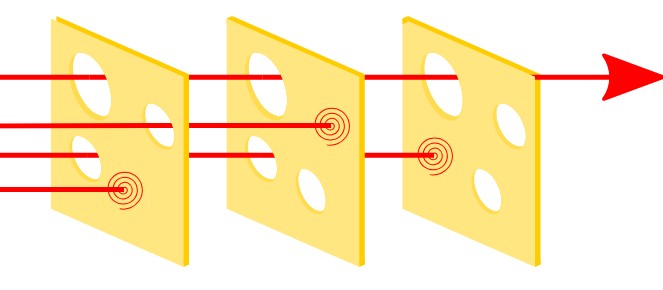
The Swiss Cheese Model is a model used in risk analysis and risk management. In summary, human systems are compared to multiple slices of Swiss cheese which are stacked side by side, each layer having holes of random sizes and positioning. These layers act as a defence against different threats, and a threat will only materialise if the holes are aligned. Therefore, a single point of failure will not cause the system to fail. While there are criticisms to this model, its application ranges from engineering, aviation, computer security and healthcare.
It has been some time since I posted a new article, mainly because I am in China now, and for the past few months China has been actively clamping down on VPNs. I do not know much about the technical details, but it has caused my website to be unable to load properly. The root cause has not been resolved, so I am taking a detour to access my site. It has been some time since I have wrote something, hence the article today may be a bit stiff in terms of writing.
Many people often have the perception that they cannot make a mistake, and if a mistake is made they wish they could restart and redo everything (which are often times impossible) or they would go all the way in and follow through with their wrong decisions, hoping the end result would justify everything.
But we are humans, and humans make mistakes. Fortunately, a single point of failure often do not cause the whole task to fail. Indeed, the best results could no longer be achieved, yet it does not mean that a decent result cannot be obtained. We take financial investments for example. Many people often have the tendency to invest heavily in a stock when there is a hype. The AI boom recently has seen many retail investors ‘all in’ their money on related stocks, but we may be starting to see signs of weaknesses. We now identify the different layers of cheese:
- Did you do your homework before investment?
- Did you put most of your money in?
- Did you borrow money to invest?
- Did you buy in a hype?
The list can go on but we will stop at 4. After identifying the risks, we need to ask ourselves how big each of the risks are and if there are ways we can patch up the holes. The more holes we patch, the lower the risk of a total failure. The end result may not be the ideal, but even Warren Buffett do not get the ideal results all the time. Our priority should be to first prevent a total collapse of the system (task) and second, to slowly work towards a better result than what we have now. As long as we are still in the game, we can have a chance.
Be it in businesses or in our financial investments or even in other aspects of our lives, we can use the Swiss Cheese Model in our daily lives and for our own risk management. For example, I intend to move around the world and live in different countries. Before stepping out of my home country and moving to a new place, I will need to identify what are the potential risks, how to prevent the whole plan from collapsing and for the holes that come out unexpectedly, to patch them as best as I can. I may not do it perfectly, but I will do as well as I can.
Do each task in your work and in your life well. I have seen many taking a flippant attitude at work and in their own lives, much to their detriment. Doing them with a good attitude will ensure there are lesser holes in the layers of cheese. A single point of failure will seldom kill you. But multiple points of failures will.
瑞士奶酪模型是一個用於風險分析和管理的模型。簡單說,人類系統就好像多層次的奶酪並排堆疊在一起,每一片奶酪都有處在不同位置和大小不一的孔洞。這些奶酪層是作為不同威脅的防線,而當每個層次有個洞對齊的時候,風險就會變成現實。所以,單點故障不會導致整個系統崩盤。雖這模型也有不少人批評,但卻也在各個行業使用,例如工程,航空,計算機安全和醫藥。
很多人有個錯誤觀念,覺得自己不能犯錯。一旦犯錯,就要重新再來(即便大多數時候是不可能的),或者就直接一錯到底,希望結果最終能合理化一切的決定。
但我們是人,是人就會犯錯。慶幸的是,單點故障通常是不會導致任務徹底失敗的。當然,最理想的結果已得不到,但也不代表一個像樣的結局就遠離我們了。我們拿投資做例子。很多人有在狂熱的時候重倉的傾向。最近的AI熱潮就有很多散戶 all in 相關股票。現在已經開始有些衰退的跡象了。我們來看看這奶酪的幾個層次。
1. 你投資前是否有做好功課?
2. 你是否已重倉?
3. 你是否加上槓桿?
4. 你是否是在熱潮的時候建倉的?
奶酪還有更多層,但這裡我就寫4層做簡單例子。識別不同的風險(奶酪層)後,我們得問自己每一層的奶酪有多大的洞,並嘗試去修補。修補的洞越多,全面崩盤的概率就越小。最終結果雖不會是最理想結果,但就連巴菲特也不是事事順利。我們第一要做的就是防止一個完敗的局面,第二就是盡可能爭取一個比現在更好的結果。只要沒被踢出局,就有翻盤的機會。
在生意上,投資上,和生活的方方面面,我們都可以用這個模型去管理風險。例如我離開了我的國家,想滿世界跑。那在踏出我的國家前,我就得找出有什麼風險,怎麼防止整個計劃的失敗,而碰到預想不到的局面時,如何盡力補救。雖不一定完美,但是會盡力。
很多人在工作上和生活上,都是非常混日子的,既不努力也不思考。把每一個’任務’用心做,奶酪的洞就越少。單點故障通常不會幹掉你,但故障多了,遲早出事。
Showing 1 - 3 out of 3
Page 1 out of 1
| - | Shop Products | Price | |
|---|---|---|---|
|
|
 |
$1.00
|
|
|
|
 |
Price range: $69.00 through $99.00
|
|
|
|
 |
$99,999.00
|